



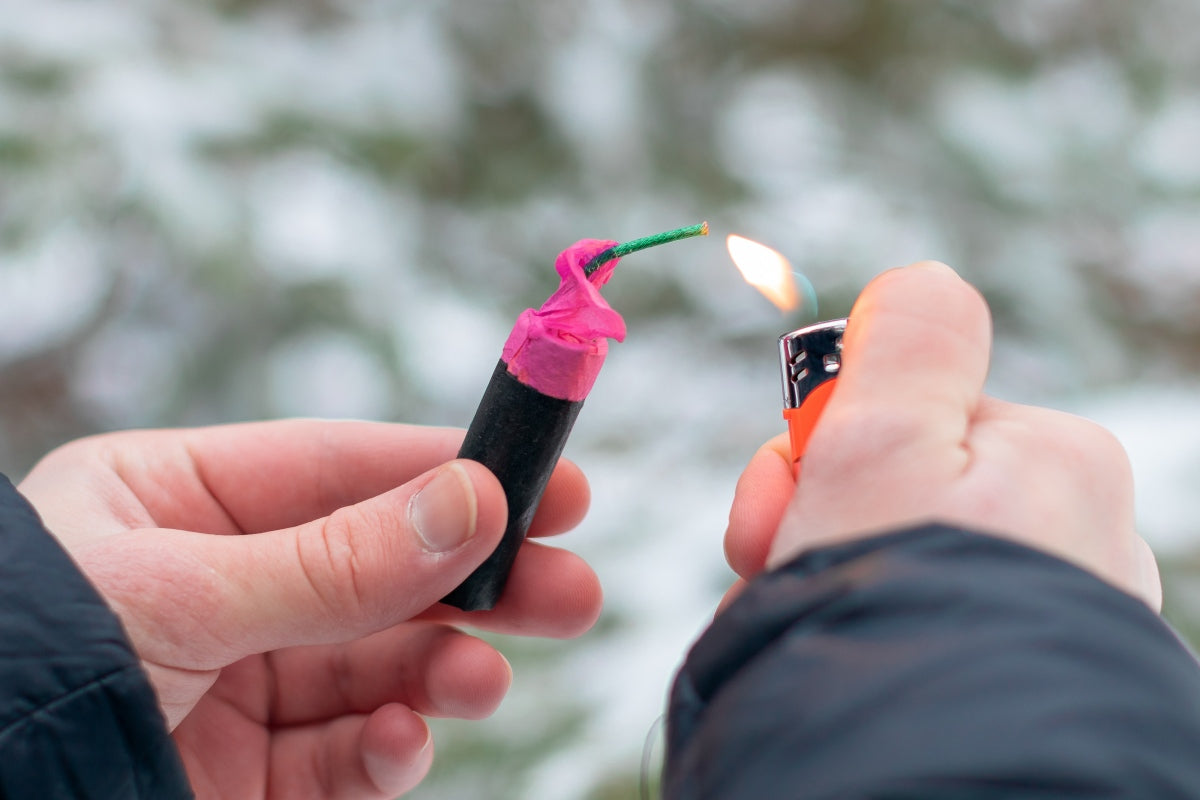
Fireworks vs hands is not a fight you want to “try once” for the plot. Fireworks are engineered to burn fast, build pressure, and launch effects hard, and your hands are not built to survive that kind of energy. That doesn't mean you can't go all out on a random Tuesday.
If you love backyard shows and big finale energy, you are in the right place. We are going to break down why holding fireworks is a bad move, what actually causes the injuries, and how to run a killer show the safe, smart way.
What this article covers:
- Why Fireworks and Hands Are a Dangerous Combination
- The Most Common Hand Injuries From Fireworks
- The Biggest Mistakes People Make
- Use Fireworks Safely Without Risking Your Hands
- Frequently Asked Questions
Why Fireworks and Hands Are a Dangerous Combination
The U.S. Consumer Product Safety Commission reports thousands of fireworks injuries each year, and hands consistently show up as a major problem area.
Here is the core issue: consumer fireworks are designed to be placed on the ground or secured in a launch tube. They are not designed to be gripped.
The moment you hold one, you turn your hand into the “launch platform,” and that is where everything can go wrong fast.
Most consumer fireworks use black powder as a lift charge, an ignition charge, or both. Black powder is typically a mix of potassium nitrate, charcoal, and sulfur.
When the fuse lights the powder, it triggers rapid exothermic oxidation, a chemical reaction that releases heat and produces expanding hot gases. That gas expansion is the whole point. It creates pressure.
In an aerial shell, pressure drives the shell up a mortar tube. In a cake, pressure launches effects through built-in tubes. In a firecracker, pressure builds until the casing fails, creating the loud report.
Your hand cannot “manage” that pressure. It only absorbs it.
Even “small” fireworks can dump a brutal amount of force into a small space. If a fuse burns faster than expected or burns inconsistently, the device can ignite while you are still holding it. That pressure release happens in a blink, and your fingers do not get a vote.

The Most Common Hand Injuries From Fireworks
You do not need to imagine what can happen. You can map most hand injuries to the same basic problem: heat plus pressure, too close, too fast.
Here's what shows up again and again:
- Burns from sparks and hot casing fragments, especially when a device flares unexpectedly
- Blast injuries from premature ignition, when pressure releases before you can step away
- Finger fractures from explosive force delivered at close range
- Severe trauma, including partial or full finger amputations, in the worst cases
Now let's talk about the “friendly-looking” stuff for a second.
Sparklers are a classic example of people underestimating heat. A sparkler can burn hot enough to cause serious burns fast, and that risk jumps when kids wave them around or someone grabs the wrong end.
It also helps to understand the difference between novelty items and aerial products.
In our experience, novelty fireworks and snaps fireworks can still hurt you if you misuse them, but they are not designed to launch heavy effects. Just follow the package instructions, and you'll be set.
Bigger items like cake fireworks, and mortar fireworks often become safer choices when you set them up correctly because the design forces distance between you and the effect.
That is the real secret. Distance is your safety superpower.
The Biggest Mistakes People Make
Here are the big ones:
- Holding fireworks while lighting them
- Relighting a dud without waiting
- Leaning over a device after ignition
- Letting kids hold sparklers without supervision
- Lighting multiple fuses at once
Leaning over a cake or tube after lighting is also a brutal mistake. The lift charge can ignite hard and fast, and it does not care that your face and hands are hovering above the device.
If you are running a backyard lineup with aerial fireworks or stacking your night with finale fireworks, treat your setup like a mini production. Light one fuse, step back immediately, and do not hover like you are trying to “coach” the firework into working.

Use Fireworks Safely Without Risking Your Hands
A safer show is not a boring show. It is the opposite. When you control the setup, you get cleaner launches, better timing, way fewer panic moments, and an epic show without the drama of an ER visit.
Set Fireworks On Flat, Stable Ground
If your firework starts crooked, it can finish crooked. Uneven driveways, soft grass, loose gravel, and sloped pavement all increase the chance of tip-overs or weird angles.
When a device tips, it can shoot sideways instead of up. That turns an “up there” problem into an “over here” problem, and that is how hands get pulled into the danger zone.
Pick a flat area. If you need to, place heavier items on a stable board and weigh it down.
Pre-built assortments and show packs keep things cleaner because they are made to sit flat and fire from stable bases. A curated fireworks box also helps you plan the order and reduce last-second improvising.
If you're still unsure, we've got a whole guide on finding the best place for fireworks that goes in depth.
Light It, Then Step Back Fast
Most hand injuries happen within one to two seconds after ignition. People light the fuse, wait to “see if it catches,” lean closer, then the device finally lights, and they are still too close.
Do the opposite.
Light from the side, extend your arm, and move back immediately. Trust the fuse. Your job is to start the ignition, then get out of the way.
This is where extended lighting tools matter. Punk lighters and long igniters give you reach and keep your hand away from sparks. It is a small move that makes a big difference in real-world safety.
It's also in your best interest to buy fireworks from reputable companies, like Red Apple Fireworks. We're not resellers. Every firework you buy from us is engineered to give you the best experience. That includes a tightly controlled quality checking process.

Control Your Distance Like a Pro
Set a firing area and a viewing area. Keep spectators back. Put kids behind a clear line for adults to see. Once the show starts, nobody crosses into the firing zone, even if something looks “off.”
If you're firing devices like rocket fireworks or roman candles, space them out so one item cannot knock into another.
A clean layout prevents chain reactions and keeps the operator zone calm.
Treat Duds Like They Are Still Live
If a firework does not go off, wait at least 15 to 20 minutes. Do not go right back in. After waiting, soak it in a bucket of water before disposal. This is not overkill. This is how you stop “second attempt” injuries.
Make a “dud plan” part of every show checklist. Set the water bucket before you light anything. If something fails, you already know what you are doing, and you do not let adrenaline make decisions.
Never Modify Fireworks Or Use Makeshift Launch Setups
If you modify fireworks, you break the engineering. That means you change how the fuse burns, how pressure builds, and where energy escapes.
You also increase unpredictability, which is exactly what destroys hands.
Do not tape items together. Do not cut casings. Do not “speed up” fuses. Do not make DIY launch tubes out of bottles or random pipes.
This matters most with artillery-style shells. Proper tubes are part of the safety system because they contain and direct the lift charge.
As fireworks professionals, we're confident in one ultimate fireworks truth: If you want that bigger sky effect, choose properly-made products and use their designed hardware.

Frequently Asked Questions
Can You Hold A Firework While Lighting It?
No. Fireworks are designed for ground placement or proper launch tubes. Holding one puts your hand next to high heat, fast ignition, and pressure release. You do not get enough time to react if something goes wrong.
Are Sparklers Safe To Hold In Your Hand?
Sparklers are safer than many devices when used correctly, but they still burn extremely hot. Supervise kids closely and place used sparklers in water after use because the wire stays hot.
What Should You Do If A Firework Does Not Go Off?
Wait at least 15 to 20 minutes. Do not relight it. Soak it in water before disposal. Treat every dud like it could still ignite.
Conclusion
If you remember one thing, remember this: fireworks vs hands has one winner every time, and it is not your fingers.
When you set fireworks on stable ground and follow product instructions, you have nothing to worry about.
At Red Apple, we performance-test and precision-tune our lineup for maximum impact, from family-friendly fireworks for kids to pro-level finale fireworks that can rival the biggest firework show.
Ready to get more bang for your buck? Stop by our store locations, ask about the Club Red Apple membership, and build a show that looks fearless while staying smart.
Ready to learn more about fireworks? Check out these articles:



Leave a comment
All comments are moderated before being published.
This site is protected by hCaptcha and the hCaptcha Privacy Policy and Terms of Service apply.